Saturday, April 25, 2015

Let's learn about englsih vowels


Describing English vowels

Repeat each of the following vowels several times in succession, paying close attention to what your tongue body is doing as you move from one vowel to the other:

[i] and [u]
[i] and [æ]
[u] and [ɑ]
[æ] and [ɑ]
If you are like most English speakers, you should have noticed that your tongue body moves backward and forward in the [i]/[u] pair: it is further forward during [i] and further backward during [u]. Similarly, your tongue body is closer to the roof of your moth during [u] than during [ɑ] -- your jaw is probably also opening wider during the [ɑ] to help increase the distance between the tongue body and the roof of the mouth. Your tongue body is higher (i.e., closer to the roof of the mouth) during [i] than during [æ]. (You may also be able to feel the [i] as somewhat further forward than [æ].) Finally, your tongue body is further forward during [æ] than during [ɑ].

The dimensions for vowels

Height and frontness/backness

The most important property in the traditional classification scheme for vowels is the highest point reached by the body of the tongue, on both the front/back and high/low dimensions. Vowels are conventionally arranged on a two-dimensional diagram, where the vertical dimension indicates the distance of the tongue body from the roof of the mouth, and where the horizontal dimension indicates the forward or backward displacement of the tongue body (with left representing further forward). The four vowels [i], [u], [æ], and [ɑ].

[i]                                             [u]
[æ]                               [ɑ]
Other vowels can be specified by the position of the tongue body relative to these four corners. In [e], for example, the tongue body is pushed forward, as it is during [i] and [æ], but it is further away from the roof of the mouth in [e] than in [i], and closer to the roof of the mouth than in [æ]. So we can place [e] on a vowel chart between [i] and [æ].

Including all the vowels of English, our diagram looks like:
   [i]                                                      [u]      
      [ɪ]                                      [ʊ]      
         [e]                                   [ə]              [o]
             [ɛ]                   [ʌ] [ɔ] 
                [æ]  [a].      [ɑ]
We distinguish three major degrees of height: high, mid, and low. We also distinguish three major degrees on the front/back dimension: front, central, and back. (Don't confuse this use of "central" with the "central" that is the opposite of "lateral".) Imposing these categories on the above diagram gives us the traditional vowel chart used in the North American linguistic tradition:


The schwa [ə] is in the exact centre of this chart. Schwa is often referred to as the neutral vowel, the vowel in which the vocal tract is in its neutral state and most closely resembles a perfect tube. All the other vowels require that the vocal tract be deformed by moving the tongue body away from its neutral position, either up or down, backward or forward.

Tense/lax
We can distinguish most English vowels from each other in terms of the high/mid/low dimension and the front/central/back dimension. But the chart above still has four cells which contain two full (non-schwa) vowels apiece. So far we have no way to tell apart the following four pairs of vowels:

[i] and [ɪ]
[e] and [ɛ]
[u] and [ʊ]
[o] and [ɔ]
In each pair, one of the vowels is higher and less centralized (further front if a front vowel, further back if a back vowel), while the other is lower and closer to the position of [ə] on the horizontal dimension. Within each of these cells, the higher and less centralized vowel is referred to as tense; the lower and more centralized vowel is referred to as lax.

Tense: [i], [e], [u], [o]
Lax: [ɪ], [ɛ], [ʊ], [ɔ]
(Those speakers who don't have [ɔ] in their dialect can try to produce one by lowering and centralizing an [o] .)

Rounding
There is another important difference among the vowels of English. When you say [u], your lips are rounded. When you say [i], your lips are spread. Vowels can be categorized according to whether they are rounded or unrounded. In English, the mid and high back vowels are rounded, the front and central vowels unrounded.

[u], [ʊ], [o], [ɔ]
[i], [ɪ], [e], [ɛ], [æ], [ɑ], [ʌ], [ə]

The [ɑ] vowel of the word [ˈfɑðɹ̩] is unrounded in most dialects of English, though in Canadian English it is often rounded at least a little.

Glides and diphthongs
Glides
When the tongue body is pushed up and forward for the high front vowel [i], it ends up underneath the hard palate. If we were to try to classify [i] as if it were a consonant, we would have to call it a voiced palatal approximant: the vocal tract is made narrower by the tongue body approaching the hard palate, but not close enough to cause a turbulent airstream. But we already have a symbol, [j], for a voiced palatal approximant.

In fact, there is very little real difference between [i] and [j]. Both can be made with the tongue in the same position. [i] acts as the central part of a syllable, and typically lasts somewhat longer than a [j]. [j] does not act as the central part of a syllable and is typically fairly short. Essentially, [j] is simply an [i] that is acting as a consonant instead of a vowel.

There is a similar relationship between the vowel [u] and the consonant [w]. The high back position of [u] puts it directly under the soft palate, where you would expct to find the velar half of a [w]. A [w] is essentially an [u] that is acting as a consonant rather a vowel.

Glide is the general term for a consonant which corresponds in this way to a vowel.

Diphthongs
Three of the English vowels introduced earlier required a sequence of two IPA symbols: [aj], [aw], and [ɔj]. This might seem like a violation of the principle that there should be a one-to-one relationship between sounds and IPA symbols. But we can now see why [aj], [aw], and [ɔj] do not really act as single, simple vowels. For a vowel like [ɑ], the tongue body moves into a low and back position and remains there for the duration of the vowel. During [aj], on the other hand, the tongue body does not remain in one place -- it is (almost constantly) in motion from one position to another.

Complex vowels like [aj] which involve a movement of the tongue body from one position to another are called diphthongs. Simple vowels like [ɑ] which maintain a relatively constantly position throughout are called monophthongs.

In the transcription of a diphthong, the first symbol represents the starting point of the tongue body and the second symbol represents the direction of movement. (It is also position to use a vowel symbol for the second half of a diphthong, with a half-circle "non-syllabic" diacritic, to indicate the exact position of the tongue body at the end of the diphthong.)

In the diphthong [aj], the tongue body begins in a low, central position, represented by the symbol [a]. The tongue body almost immediately begins to move upward and forward, toward the position for an [i]. Usually, especially in facter speech, the tongue body does not have time to get all the way to the [i] position, so the diphthong often ends nearer to [ɪ] or even [e]. In a narrower transcription, we could record the precise ending position, as in [ai̯], [aɪ̯], or [ae̯]. None of these differences can change the meaning of an English word, so in a broad transcription we simply use [j], the symbol for the glide corresponding to [i], to represent the direction and approximate end-point of the diphthong.

In the diphthong [aw], the tongue body again begins in the low central position, [a], and then moves upward and backward toward the position of [u]. Often, the tongue body only manages to get part-way. We could transcribe the diphthong narrowly, as [au̯], [aʊ̯], or [ao̯], or broadly as [aw], using the symbol for the glide corresponding to [u].

In the diphthong [ɔj], the tongue body begins in the position of the lax mid back vowel [ɔ]. It moves upward and forward, toward the position of [i].

In most dialects of English, even the vowels of bait and boat, which we have been transcribing with the single symbols [e] and [o], are really diphthongs. They begin in the tense mid position but then proceed to move upward toward the position for [i] and [u] respectively. For this reason, you will often see [e] transcribed as [ej], [eɪ̯], or [ei̯], and [o] transcribed as [ow], [oʊ̯], or [ou̯].

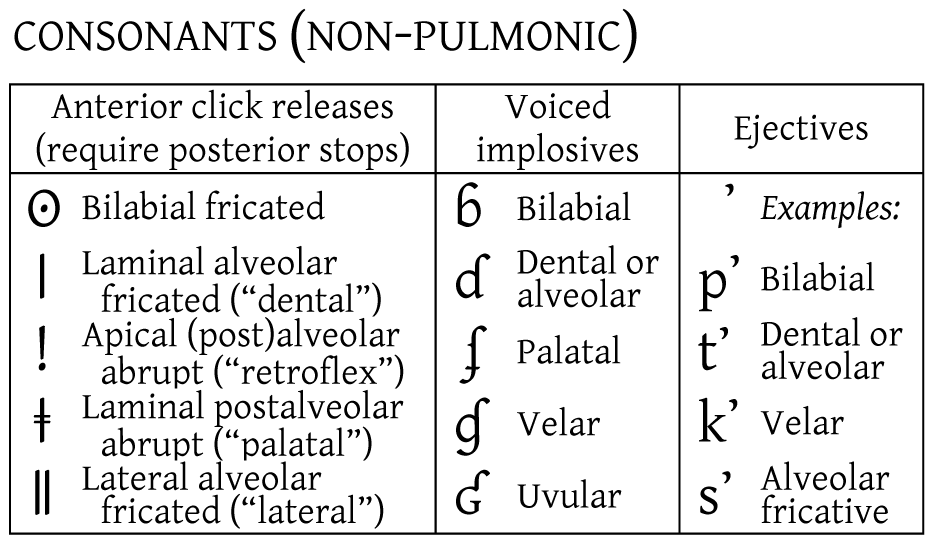
Consonants (Non-Pulmonic)
Clicks
Voiced implosives
Ejectives
ʘ
Bilabial
ɓ
Bilabial
ʼ
Examples:
ǀ
Dental
ɗ
Dental/alveolar
Bilabal
ǃ
(Post)alveolar
ʄ
Palatal
Dental/alveolar
ǂ
Palatoalveolar
ɠ
Velar
Velar
ǁ
Alveolar lateral
ʛ
Uvular
Alveolar fricative

let's study english consonants through audio-video


what are english vowels? how many of them actually?

How many vowels of english do you actually know? Are they a, i, u, e and o? wrong! now you'd better watch this video of english vowels.


Friday, April 24, 2015

How Good Is Your Reading Comprehension?

If you are a Junior high school student and you are dare to test your ability of reading skill. this is your opportunity to prove it.


are you not sure the answers? write me or send me a reply in order to get the correct answers.


Gems Stone Business Offer!


GEMS STONE BUSINESS OFFER!

“Indonesia has now come back into stone age!” that’s what happening now. But wait, stones meant here is gems stones. Gems  stones have now become trendsetting and row model in Indonesia. A lot of indoneisians men and women, young and old now are proud and happy to have gems stone on his/her finger. They even have more than one gems stones on their fingers!
So many investors have spent eagerly their big funds dealing with this kind of business. And they got their investment back with profits in short periode of time.
In this golden chance, I also offer  you to do the business and what I have is ruby gems stone of Lebong, Bengkulu province. And I provide the stones in row material only!
My business schemes:
Stone gems       : Ruby pink
Origin               : Lebong, Bengkulu.
Price at 1kg      : IDR 800,000 (can be devided into 15 - 20 small stones )
Delivery price   : excluded
Ready stock!

Interested? Please call me at 081284266955 (budi malau)
for further info please visit: 


Thursday, April 23, 2015

Apartemen Disewakan/Rented

Disewakan Murah Bulanan / Tahunan Apartemen The Green Pramuka – 2 BR Semi Furnished


  • Apartment Name: The Green Pramuka
  • Location: Jl. Jenderal Ahmad Yani Kav. 49, Jakarta Pusat 10570
  • Tower/Floor/View: Faggio / 26 / City and Mountain View
  • Size: 33 m2
  • Bedroom: 2
  • Bathroom: 1
  • Condition: Semi Furnished : 1 AC in master bedroom, 1 exhaust fan connecting master bedroom to small bedroom, 1 spring bed (160 x 200) in master bedroom, 1 clothes cabinet in master bedroom, basic kitchen, 1 exhaust fan from kitchen to outdoor space, sofa 2 seaters, refrigerator, TV table
  • Facility: – Swimming pool in each tower – Children’s Playground – Common garden with gazebos, fish pond, and jogging path – Basement parking – Lift with individual Access Card according to floor – 24hrs Security – ATM BRI – Food Court
  • Additional Info: 
    Easy Access: – 2 Toll Road gates (Rawamangun & Pulomas) – Front Entrance: Jl. A. Yani, By Pass – Jakarta Pusat (Busway Route Tj.Priok – Cawang UKI) – Back Entrance: Jl. Pramuka, Jl. Rawasari, Jl. Percetakan Negara – Jakarta Pusat – Front entrance exactly by RAWASARI Transjakarta Busway shelter (route Cawang Tj.Priok) – Back entrance by PRAMUKA Transjakarta Busway shelter (route Pulogadung-Pramuka- Manggarai-Dukuh Atas)
Strategic Location: – Near shopping centers: Carrefour Cempaka Putih, ITC Cempaka Mas, MOI Kelapa Gading (Mall Of Indonesia), Mal Artha Gading, Arion Mall Rawamangun – Near educational institutions: Labs School Rawamangun, Tarakanita Rawamangun, Al Azhar Rawamangun, IKIP Jakarta/UNJ, Jayabaya, Sevilla International School, FKUI/MMUI Salemba
Others: – Free maintenance charge ’til November 2013 (Rp 250.000 monthly maintenance charge already included in renting fee until November 2013) – Monthly electricity and water bills are excluded of the renting fee and are to be paid for by tenants monthly. Electricity: 1300 watt Area free of flood.


  • Rent Charge: Rp. 30.000.000/year or Rp 2.500.000/month
  • Contact Number: +6281284266955 ( budi malau)
  • E-mail:troymalaupase@gmail.com


Sunday, April 19, 2015

The sounds of English and the International Phonetic Alphabet


The sounds of English and the International Phonetic Alphabet

This chart contains all the sounds (phonemes) used in the English language. For each sound, it gives:
·         The symbol from the International Phonetic Alphabet (IPA), as used in phonetic transcriptions in modern dictionaries for English learners — that is, in A. C. Gimson’s phonemic system with a few additional symbols.
The chart represents British and American phonemes with one symbol. One symbol can mean two different phonemes in American and British English. See the footnotes for British-only and American-only symbols.
  • Two English words which use the sound. The underline shows where the sound is heard.
  • The links labeled Amer and Brit play sound recordings (Flash is required) where the words are pronounced in American and British English. The British version is given only where it is very different from the American version.
To print the chart, use the printable PDF version.
vowels
IPA
examples
listen

ʌ
cup, luck

ɑ:
arm, father

æ
cat, black

e
met, bed
1
ə
away, cinema
2
ɜ:ʳ
turn, learn
2
ɪ
hit, sitting

i:
see, heat

ɒ
hot, rock
3
ɔ:
call, four
4 5
ʊ
put, could

u:
blue, food

aɪ
five, eye

aʊ
now, out

eɪ
say, eight

oʊ
go, home
6
ɔɪ
boy, join

ʳ
where, air
1 7
ɪəʳ
near, here
7
ʊəʳ
pure, tourist
7
consonants
IPA
examples
listen

b
bad, lab

d
did, lady

f
find, if

g
give, flag

h
how, hello

j
yes, yellow

k
cat, back

l
leg, little

m
man, lemon

n
no, ten

ŋ
sing, finger

p
pet, map

r
red, try
8
s
sun, miss

ʃ
she, crash

t
tea, getting
9
tʃ
check, church

θ
think, both

ð
this, mother

v
voice, five

w
wet, window

z
zoo, lazy

ʒ
pleasure, vision

dʒ
just, large

  1. 1. Almost all dictionaries use the e symbol for the vowel in bed. The problem with this convention is that e in the IPA does not stand for the vowel in bed; it stands for a different vowel that is heard, for example, in the German word Seele. The “proper” symbol for the bed vowel is ɛ (do not confuse with ɜ:). The same goes for vs. ɛə.
  2. 2. In əʳ and ɜ:ʳ, the ʳ is not pronounced in BrE, unless the sound comes before a vowel (as in answering, answer it). In AmE, the ʳ is always pronounced, and the sounds are sometimes written as ɚ and ɝ.
  3. 3. In AmE, ɑ: and ɒ are one vowel, so calm and cot have the same vowel. In American transcriptions, hot is written as hɑ:t.
  4. 4. About 40% of Americans pronounce ɔ: the same way as ɑ:, so that caught and cot have the same vowel. See cot-caught merger.
  5. 5. In American transcriptions, ɔ: is often written as ɒ: (e.g. law = lɒ:), unless it is followed by r, in which case it remains an ɔ:.
  6. 6. In British transcriptions, oʊ is usually represented as əʊ. For some BrE speakers, oʊ is more appropriate (they use a rounded vowel) — for others, the proper symbol is əʊ. For American speakers, oʊ is usually more accurate.
  7. 7. In ʳ ɪəʳ ʊəʳ, the r is not pronounced in BrE, unless the sound comes before a vowel (as in dearest, dear Ann). In AmE, the r is always pronounced, and the sounds are often written as er ɪr ʊr.
  8. 8. All dictionaries use the r symbol for the first sound in red. The problem with this convention is that r in the IPA does not stand for the British or American r; it stands for the “hard” r that is heard, for example, in the Spanish word rey or Italian vero. The “proper” symbol for the red consonant is ɹ.
  9. 9. In American English, t is often pronounced as a flap t, which sounds like d or (more accurately) like the quick, hard r heard e.g. in the Spanish word pero
special symbols
IPA
what it means
ˈ
The vertical line (ˈ) is used to show word stress. It is placed before the stressed syllable in a word. For example, /ˈkɒntrækt/ is pronounced like this, and /kənˈtrækt/ like that. Word stress is explained in our article about phonetic transcription.
ʳ
ʳ is not a sound — it is a short way of saying that an r is pronounced only in American English. For example, if you write that the pronunciation of bar is /bɑ:ʳ/, you mean that it is /bɑ:r/ in American English, and /bɑ:/ in British English.
However, in BrE, r will be heard if ʳ is followed by a vowel. For example, far gone is pronounced /ˈfɑ: ˈgɒn/ in BrE, but far out is pronounced /ˈfɑ: ˈraʊt/.
i
i is usually pronounced like a shorter version of i:, but sometimes (especially in an old-fashioned British accent) it can sound like ɪ. Examples: very /ˈveri/, create /kriˈeɪt/, previous /ˈpri:viəs/, ability /əˈbɪlɪti/.
əl
əl means that the consonant l is pronounced as a separate syllable (the syllabic l, which sounds like a vowel), or that there is a short ə sound before it. Examples: little /ˈlɪtəl/, uncle ʌŋkəl/.
Instead of the əl symbol, some dictionaries use an l with a small vertical line underneath, or simply l, as in /ˈlɪtl/.
ən
ən means that the consonant n is pronounced as a separate syllable (the syllabic n, which sounds like a vowel), or that there is a short ə sound before it. Examples: written /ˈrɪtən/, listen /ˈlɪsən/.
Instead of the ən symbol, some dictionaries use an n with a small vertical line underneath, or simply n, as in /ˈrɪtn/.

Does this chart list all the sounds that you can hear in British and American English?

No. This page contains symbols used in phonetic transcriptions in modern dictionaries for English learners. It does not list all the possible sounds in American or British English.
For example, this page does not list the regular t (heard in this pronunciation of letter) and the flap t (heard in this one) with separate symbols. It groups them under a single symbol: t. (In other words, it groups a number of similar sounds under a single phoneme, for simplicity. To understand how sounds are grouped into phonemes, read the article on phonemic transcription.)
So this page actually lists phonemes (groups of sounds), not individual sounds. Each symbol in the chart can correspond to many different (but similar) sounds, depending on the word and the speaker’s accent.
Take the phoneme p in the above chart. It occurs in the phonemic transcriptions of pin /pɪn/ and spin /spɪn/. In pin, this phoneme is pronounced with aspiration (breathing). This “aspirated p” sound has its own special symbol in the IPA: pʰ. In spin, the phoneme is pronounced “normally”; this “normal p” sound is represented by p in the IPA. So the p phoneme represents two sounds: p and pʰ. (This can be confusing, because p can mean both the p phoneme and the p sound.)

Learning to pronounce the sounds

I have developed English pronunciation software called PerfectPronunciation which teaches learners to pronounce the most frequently used English words. It lets you listen to examples of English sounds, practice your pronunciation, and review your knowledge. PerfectPronunciation uses the ASCII Phonetic Alphabet.
Consonants
Main article: Consonant
Place →
↓ Manner
m


n


p
b
t
d


c
k
q


s
z


f
v


x
h


j


r


*


 *


l


ɺ̢ *


w
— These tables contain phonetic symbols, which may not display correctly in some browsers. [Help]
— Where symbols appear in pairs, left–right represent the voiceless–voiced consonants.
— Shaded areas denote pulmonic articulations judged to be impossible.
— Symbols marked with an asterisk (*) are not defined in the IPA.
Notes
  • Asterisks (*) indicate unofficial IPA symbols for attested sounds. See the respective articles for ad hoc symbols found in the literature.
  • In rows where some letters appear in pairs (the obstruents), the letter to the right represents a voiced consonant (except breathy-voiced [ɦ]). However, [ʔ] cannot be voiced, and the voicing of [ʡ] is ambiguous.[39] In the other rows (the sonorants), the single letter represents a voiced consonant.
  • Although there is a single letter for the coronal places of articulation for all consonants but fricatives, when dealing with a particular language, the letters may be treated as specifically dental, alveolar, or post-alveolar, as appropriate for that language, without diacritics.
  • Shaded areas indicate articulations judged to be impossible.
  • The letters [ʁ, ʕ, ʢ] represent either voiced fricatives or approximants.
  • In many languages, such as English, [h] and [ɦ] are not actually glottal, fricatives, or approximants. Rather, they are bare phonation.[40]
  • It is primarily the shape of the tongue rather than its position that distinguishes the fricatives [ʃ ʒ], [ɕ ʑ], and [ʂ ʐ].
  • The labiodental nasal [ɱ] is not known to exist as a phoneme in any language.[41]
Pulmonic consonants
A pulmonic consonant is a consonant made by obstructing the glottis (the space between the vocal cords) or oral cavity (the mouth) and either simultaneously or subsequently letting out air from the lungs. Pulmonic consonants make up the majority of consonants in the IPA, as well as in human language. All consonants in the English language fall into this category.[42]
The pulmonic consonant table, which includes most consonants, is arranged in rows that designate manner of articulation, meaning how the consonant is produced, and columns that designate place of articulation, meaning where in the vocal tract the consonant is produced. The main chart includes only consonants with a single place of articulation.
Co-articulated consonants
Co-articulated consonants are sounds that involve two simultaneous places of articulation (are pronounced using two parts of the vocal tract). In English, the [w] in "went" is a coarticulated consonant, because it is pronounced by rounding the lips and raising the back of the tongue. Other languages, such as French and Swedish, have different coarticulated consonants.
Note
Affricates and double articulated consonants
Affricates and doubly articulated stops are represented by two letters joined by a tie bar, either above or below the letters.[44] The six most common affricates are optionally represented by ligatures, though this is no longer official IPA usage,[1] because a great number of ligatures would be required to represent all affricates this way. Alternatively, a superscript notation for a consonant release is sometimes used to transcribe affricates, for example tˢ for t͡s, paralleling kˣ ~ k͡x. The letters for the palatal plosives c and ɟ, are often used as a convenience for t͡ʃ and d͡ʒ or similar affricates, even in official IPA publications, so they must be interpreted with care.
Tie bar
Ligature
Description
ʦ
voiceless alveolar affricate
ʣ
voiced alveolar affricate
ʧ
voiceless postalveolar affricate
ʤ
voiced postalveolar affricate
ʨ
voiceless alveolo-palatal affricate
ʥ
voiced alveolo-palatal affricate
 –
voiceless alveolar lateral affricate
 –
voiceless labial-velar plosive
 –
voiced labial-velar plosive
 –
labial-velar nasal stop
 –
voiced velar affricate
Note
  • On browsers that use Arial Unicode MS to display IPA characters, the following incorrectly formed sequences may look better due to a bug in that font: ts͡, tʃ͡, tɕ͡, dz͡, dʒ͡, dʑ͡, tɬ͡, kp͡, ɡb͡, ŋm͡.
Non-pulmonic consonants
Non-pulmonic consonants are sounds whose airflow is not dependent on the lungs. These include clicks (found in the Khoisan languages of Africa), implosives (found in languages such as Sindhi, Saraiki, Swahili and Vietnamese), and ejectives (found in many Amerindian and Caucasian languages).
Bilabial
Bilabial
ʼ
For example:
Laminal alveolar ("dental")
Alveolar
Bilabial
Apical (post-)alveolar ("retroflex")
Palatal
Alveolar
Laminal postalveolar ("palatal")
Velar
Velar
Lateral coronal ("lateral")
Uvular
Alveolar fricative
Notes
  • Clicks are double articulated and have traditionally been described as having a forward 'release' and a rear 'accompaniment', with the click letters representing the release. Therefore all clicks would require two letters for proper notation: k͡ǂ, ɡ͡ǂ, ŋ͡ǂ, q͡ǂ, ɢ͡ǂ, ɴ͡ǂ etc., or ǂ͡k, ǂ͡ɡ, ǂ͡ŋ, ǂ͡q, ǂ͡ɢ, ǂ͡ɴ. When the dorsal articulation is omitted, a [k] may usually be assumed. However, recent research disputes the concept of 'accompaniment'.[45] In these approaches, the click letter represents both articulations, with the different letters representing different click 'types', there is no velar-uvular distinction, and the accompanying letter represents the manner, phonation, or airstream contour of the click: ǂ, ᶢǂ, ᵑǂ etc.
  • Letters for the voiceless implosives ƥ, ƭ, ƈ, ƙ, ʠ are no longer supported by the IPA, though they remain in Unicode. Instead, the IPA typically uses the voiced equivalent with a voiceless diacritic: ɓ̥, ʛ̥⟩, etc..
  • Although not confirmed as contrastive in any language, and therefore not explicitly recognized by the IPA, a letter for the retroflex implosive, , is supported in the Unicode Phonetic Extensions Supplement, added in version 4.1 of the Unicode Standard, or can be created as a composite ɗ̢⟩.
  • The ejective diacritic often stands in for a superscript glottal stop in glottalized but pulmonic sonorants, such as [mˀ], [lˀ], [wˀ], [aˀ]. These may also be transcribed as creaky [m̰], [l̰], [w̰], [a̰].

Consonants
Representations of consonant sounds outside of the core set are created by adding diacritics to letters with similar sound values. The Spanish bilabial and dental approximants are commonly written as lowered fricatives, [β̞] and [ð̞] respectively. Similarly, voiced lateral fricatives would be written as raised lateral approximants, [ɭ˔ ʎ̝ ʟ̝]. A few languages such as Banda have a bilabial flap as the preferred allophone of what is elsewhere a labiodental flap. It has been suggested that this be written with the labiodental flap letter and the advanced diacritic, [ⱱ̟].[55]
Similarly, a labiodental trill would be written [ʙ̪] (bilabial trill and the dental sign), and labiodental stops [p̪ b̪] rather than with the ad hoc letters sometimes found in the literature. Other taps can be written as extra-short plosives or laterals, e.g. [ɟ̆ ɢ̆/ʀ̆ ʟ̆], though in some cases the diacritic would need to be written below the letter. A retroflex trill can be written as a retracted [r̠], just as retroflex fricatives sometimes are. The remaining consonants, the uvular laterals (ʟ̠ etc.) and the palatal trill, while not strictly impossible, are very difficult to pronounce and are unlikely to occur even as allophones in the world's languages.

Vowels
The vowels are similarly manageable by using diacritics for raising, lowering, fronting, backing, centering, and mid-centering.[56] For example, the unrounded equivalent of [ʊ] can be transcribed as mid-centered [ɯ̽], and the rounded equivalent of [æ] as raised [ɶ̝]. True mid vowels are lowered [e̞ ø̞ ɘ̞ ɵ̞ ɤ̞ o̞], while centered [ɪ̈ ʊ̈] and [ä] are near-close and open central vowels, respectively. The only known vowels that cannot be represented in this scheme are vowels with unexpected roundedness, which would require a dedicated diacritic, such as ʏʷ and uᵝ (or ɪʷ and ɯ).