The sounds of English and the International Phonetic Alphabet
This chart contains all the sounds (phonemes) used in the English language. For each sound, it gives:
·
The symbol from the International
Phonetic Alphabet (IPA), as used in phonetic transcriptions
in modern dictionaries for English learners — that is, in A. C. Gimson’s
phonemic system with a few additional symbols.
The chart represents British and American
phonemes with one symbol. One symbol can mean two different phonemes in
American and British English. See the footnotes for British-only and
American-only symbols.
- Two English words which use the sound. The underline shows where the sound is heard.
- The links labeled Amer and Brit play sound recordings (Flash is required) where the words are pronounced in American and British English. The British version is given only where it is very different from the American version.
|
|
||||||||||||||||||||||||||||||||||||||||||||||||||||||||||||||||||||||||||||||||||||||||||||||||||||||||||||||||||||||||||||||||||||||||||||||||||||||||||||||||||||||||||||||||||||||||||||||||
- 1. Almost all dictionaries use the
esymbol for the vowel in bed. The problem with this convention is thatein the IPA does not stand for the vowel in bed; it stands for a different vowel that is heard, for example, in the German word Seele. The “proper” symbol for the bed vowel isɛ(do not confuse withɜ:). The same goes foreəvs.ɛə. - 2. In
əʳandɜ:ʳ, theʳis not pronounced in BrE, unless the sound comes before a vowel (as in answering, answer it). In AmE, theʳis always pronounced, and the sounds are sometimes written asɚandɝ. - 3. In AmE,
ɑ:andɒare one vowel, so calm and cot have the same vowel. In American transcriptions, hot is written ashɑ:t. - 4. About 40% of Americans pronounce
ɔ:the same way asɑ:, so that caught and cot have the same vowel. See cot-caught merger. - 5. In American transcriptions,
ɔ:is often written asɒ:(e.g. law =lɒ:), unless it is followed byr, in which case it remains anɔ:. - 6. In British transcriptions,
oʊis usually represented asəʊ. For some BrE speakers,oʊis more appropriate (they use a rounded vowel) — for others, the proper symbol isəʊ. For American speakers,oʊis usually more accurate. - 7. In
eəʳɪəʳʊəʳ, theris not pronounced in BrE, unless the sound comes before a vowel (as in dearest, dear Ann). In AmE, theris always pronounced, and the sounds are often written aserɪrʊr. - 8. All dictionaries use the
rsymbol for the first sound in red. The problem with this convention is thatrin the IPA does not stand for the British or American r; it stands for the “hard” r that is heard, for example, in the Spanish word rey or Italian vero. The “proper” symbol for the red consonant isɹ. - 9. In American English,
tis often pronounced as a flap t, which sounds likedor (more accurately) like the quick, hard r heard e.g. in the Spanish word pero.
|
special symbols
|
|
|
IPA
|
what it means
|
ˈ |
The vertical line (
ˈ)
is used to show word stress. It is placed before the stressed syllable in a
word. For example, /ˈkɒntrækt/ is pronounced like
this, and /kənˈtrækt/ like
that. Word
stress is explained in our article about phonetic transcription. |
ʳ |
ʳ
is not a sound — it is a short way of saying that an r is pronounced only in American
English. For example, if you write that the pronunciation of bar is /bɑ:ʳ/, you mean that it is /bɑ:r/ in American English, and /bɑ:/ in British English. |
i |
|
əl |
əl means that the consonant l is pronounced as a separate syllable
(the syllabic l, which sounds like a vowel), or that there is a short ə sound before it. Examples: little
/ˈlɪtəl/, uncle
/ˈʌŋkəl/.
Instead of the
əl symbol, some dictionaries use an l with a small vertical line
underneath, or simply l,
as in /ˈlɪtl/. |
ən |
ən means that the consonant n is pronounced as a separate syllable
(the syllabic n, which sounds like a vowel), or that there is a short ə sound before it. Examples: written
/ˈrɪtən/, listen
/ˈlɪsən/.
Instead of the
ən symbol, some dictionaries use an n with a small vertical line
underneath, or simply n,
as in /ˈrɪtn/. |
Does this chart list all the sounds that you can hear in British and American English?
No. This page contains symbols used in phonetic transcriptions in modern dictionaries for English learners. It does not list all the possible sounds in American or British English.For example, this page does not list the regular t (heard in this pronunciation of letter) and the flap t (heard in this one) with separate symbols. It groups them under a single symbol:
t. (In other words, it groups a number
of similar sounds under a single phoneme, for simplicity. To
understand how sounds are grouped into phonemes, read the article on phonemic
transcription.) So this page actually lists phonemes (groups of sounds), not individual sounds. Each symbol in the chart can correspond to many different (but similar) sounds, depending on the word and the speaker’s accent.
Take the phoneme
p in the
above chart. It occurs in the phonemic transcriptions of pin /pɪn/ and spin /spɪn/. In pin,
this phoneme is pronounced with aspiration (breathing). This “aspirated p”
sound has its own special symbol in the IPA: pʰ.
In spin, the phoneme is
pronounced “normally”; this “normal p” sound is represented by p in the IPA. So the p phoneme represents two sounds:
p and pʰ. (This can be
confusing, because p can
mean both the p phoneme and
the p sound.) Learning to pronounce the sounds
I have developed English pronunciation software called PerfectPronunciation which teaches learners to pronounce the most frequently used English words. It lets you listen to examples of English sounds, practice your pronunciation, and review your knowledge. PerfectPronunciation uses the ASCII Phonetic Alphabet.
Consonants
Main
article: Consonant
|
Place →
|
||||||||||||||||||||||||||
|
↓ Manner
|
||||||||||||||||||||||||||
|
ꞎ *
|
||||||||||||||||||||||||||
|
ɺ̢ *
|
||||||||||||||||||||||||||

|
— Shaded areas denote pulmonic articulations judged to be
impossible.
|
|
— Symbols marked with an asterisk (*) are not defined in
the IPA.
|
Notes
- Asterisks (*) indicate unofficial IPA symbols for attested sounds. See the respective articles for ad hoc symbols found in the literature.
- In rows where some letters appear in pairs (the obstruents), the letter to the right represents a voiced consonant (except breathy-voiced [ɦ]). However, [ʔ] cannot be voiced, and the voicing of [ʡ] is ambiguous.[39] In the other rows (the sonorants), the single letter represents a voiced consonant.
- Although there is a single letter for the coronal places of articulation for all consonants but fricatives, when dealing with a particular language, the letters may be treated as specifically dental, alveolar, or post-alveolar, as appropriate for that language, without diacritics.
- Shaded areas indicate articulations judged to be impossible.
- The letters [ʁ, ʕ, ʢ] represent either voiced fricatives or approximants.
- In many languages, such as English, [h] and [ɦ] are not actually glottal, fricatives, or approximants. Rather, they are bare phonation.[40]
- It is primarily the shape of the tongue rather than its position that distinguishes the fricatives [ʃ ʒ], [ɕ ʑ], and [ʂ ʐ].
- The labiodental nasal [ɱ] is not known to exist as a phoneme in any language.[41]
Pulmonic
consonants
A pulmonic consonant is a consonant made by
obstructing the glottis (the space between the vocal cords) or
oral cavity (the mouth) and either simultaneously
or subsequently letting out air from the lungs. Pulmonic consonants make up the
majority of consonants in the IPA, as well as in human language. All consonants
in the English language fall into this category.[42]
The pulmonic
consonant table, which includes most consonants, is arranged in rows that
designate manner
of articulation, meaning how the consonant
is produced, and columns that designate place
of articulation, meaning where in
the vocal tract the consonant is produced. The main chart includes only consonants
with a single place of articulation.
Co-articulated
consonants
Co-articulated
consonants are sounds that
involve two simultaneous places
of articulation (are pronounced
using two parts of the vocal tract). In English, the [w] in
"went" is a coarticulated consonant, because it is pronounced by
rounding the lips and raising the back of the tongue. Other languages, such as French and Swedish, have different coarticulated
consonants.
Note
- [ɧ] is described as a "simultaneous [ʃ] and [x]".[43] However, this analysis is disputed. (See voiceless palatal-velar fricative for discussion.)
Affricates
and double articulated consonants
Affricates and doubly
articulated stops are
represented by two letters joined by a tie bar, either above or below the
letters.[44] The six most common affricates are
optionally represented by ligatures, though this is no longer official IPA
usage,[1]
because a great number of ligatures would be required to represent all
affricates this way. Alternatively, a superscript notation for a consonant
release is sometimes used to transcribe affricates, for example tˢ
for t͡s, paralleling kˣ
~ k͡x. The letters for the palatal plosives
c and ɟ,
are often used as a convenience for t͡ʃ and d͡ʒ or similar affricates, even in
official IPA publications, so they must be interpreted with care.
|
Tie bar
|
Ligature
|
Description
|
|
ʦ
|
voiceless
alveolar affricate
|
|
|
ʣ
|
voiced
alveolar affricate
|
|
|
ʧ
|
voiceless
postalveolar affricate
|
|
|
ʤ
|
voiced
postalveolar affricate
|
|
|
ʨ
|
voiceless
alveolo-palatal affricate
|
|
|
ʥ
|
voiced
alveolo-palatal affricate
|
|
|
–
|
voiceless
alveolar lateral affricate
|
|
|
–
|
voiceless
labial-velar plosive
|
|
|
–
|
voiced
labial-velar plosive
|
|
|
–
|
labial-velar
nasal stop
|
|
|
–
|
voiced
velar affricate
|
|
Note
- On browsers that use Arial Unicode MS to display IPA characters, the following incorrectly formed sequences may look better due to a bug in that font: ts͡, tʃ͡, tɕ͡, dz͡, dʒ͡, dʑ͡, tɬ͡, kp͡, ɡb͡, ŋm͡.
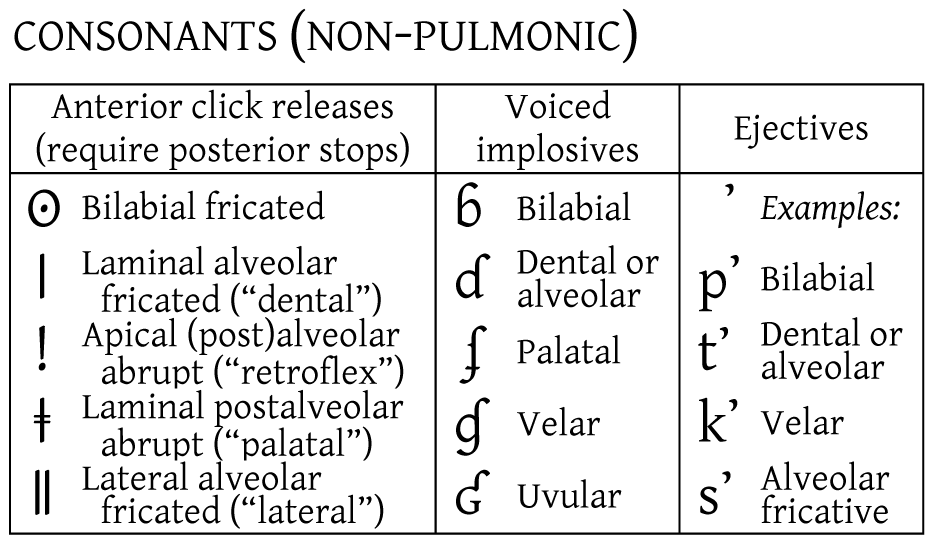
Non-pulmonic
consonants
Non-pulmonic
consonants are sounds whose airflow is not dependent on the lungs. These
include clicks (found in the Khoisan languages of Africa), implosives (found in languages such as Sindhi, Saraiki, Swahili and Vietnamese), and ejectives (found in many Amerindian and Caucasian
languages).
|
Bilabial
|
Bilabial
|
ʼ
|
For example:
|
||
|
Laminal
alveolar ("dental")
|
Alveolar
|
Bilabial
|
|||
|
Apical
(post-)alveolar ("retroflex")
|
Palatal
|
Alveolar
|
|||
|
Laminal
postalveolar ("palatal")
|
Velar
|
Velar
|
|||
|
Lateral
coronal ("lateral")
|
Uvular
|
Alveolar
fricative
|
|||
Notes
- Clicks are double articulated and have traditionally been described as having a forward 'release' and a rear 'accompaniment', with the click letters representing the release. Therefore all clicks would require two letters for proper notation: ⟨k͡ǂ, ɡ͡ǂ, ŋ͡ǂ, q͡ǂ, ɢ͡ǂ, ɴ͡ǂ⟩ etc., or ⟨ǂ͡k, ǂ͡ɡ, ǂ͡ŋ, ǂ͡q, ǂ͡ɢ, ǂ͡ɴ⟩. When the dorsal articulation is omitted, a [k] may usually be assumed. However, recent research disputes the concept of 'accompaniment'.[45] In these approaches, the click letter represents both articulations, with the different letters representing different click 'types', there is no velar-uvular distinction, and the accompanying letter represents the manner, phonation, or airstream contour of the click: ⟨ǂ, ᶢǂ, ᵑǂ⟩ etc.
- Letters for the voiceless implosives ⟨ƥ, ƭ, ƈ, ƙ, ʠ⟩ are no longer supported by the IPA, though they remain in Unicode. Instead, the IPA typically uses the voiced equivalent with a voiceless diacritic: ⟨ɓ̥, ʛ̥⟩, etc..
- Although not confirmed as contrastive in any language, and therefore not explicitly recognized by the IPA, a letter for the retroflex implosive, ⟨ᶑ⟩, is supported in the Unicode Phonetic Extensions Supplement, added in version 4.1 of the Unicode Standard, or can be created as a composite ⟨ɗ̢⟩.
- The ejective diacritic often stands in for a superscript glottal stop in glottalized but pulmonic sonorants, such as [mˀ], [lˀ], [wˀ], [aˀ]. These may also be transcribed as creaky [m̰], [l̰], [w̰], [a̰].
Consonants
Representations of
consonant sounds outside of the core set are created by adding diacritics to
letters with similar sound values. The Spanish bilabial and dental approximants
are commonly written as lowered fricatives, [β̞]
and [ð̞] respectively. Similarly, voiced
lateral fricatives would be written as raised lateral approximants, [ɭ˔ ʎ̝ ʟ̝]. A few languages such as Banda
have a bilabial flap as the preferred allophone of what is elsewhere a
labiodental flap. It has been suggested that this be written with the
labiodental flap letter and the advanced diacritic, [ⱱ̟].[55]
Similarly, a
labiodental trill would be written [ʙ̪] (bilabial trill and the dental sign),
and labiodental stops [p̪
b̪] rather than with the ad hoc
letters sometimes found in the literature. Other taps can be written as
extra-short plosives or laterals, e.g. [ɟ̆ ɢ̆/ʀ̆ ʟ̆], though in some cases the diacritic
would need to be written below the letter. A retroflex trill can be written as
a retracted [r̠], just as retroflex fricatives
sometimes are. The remaining consonants, the uvular laterals (ʟ̠ etc.) and the palatal trill,
while not strictly impossible, are very difficult to pronounce and are unlikely
to occur even as allophones in the world's languages.
Vowels
The vowels are
similarly manageable by using diacritics for raising, lowering, fronting,
backing, centering, and mid-centering.[56] For example, the unrounded equivalent
of [ʊ]
can be transcribed as mid-centered [ɯ̽], and the rounded equivalent of [æ] as
raised [ɶ̝].
True mid vowels are lowered [e̞
ø̞ ɘ̞ ɵ̞ ɤ̞ o̞],
while centered [ɪ̈
ʊ̈]
and [ä] are near-close and open central vowels, respectively. The only known
vowels that cannot be represented in this scheme are vowels with unexpected roundedness, which would require a dedicated
diacritic, such as ⟨ʏʷ⟩ and ⟨uᵝ⟩
(or ⟨ɪʷ⟩
and ⟨ɯᵝ⟩).


No comments:
Post a Comment